
What is EPS (Earnings Per Share) – Complete Guide with Examples

What is EPS (Earnings Per Share)?
Earnings Per Share (EPS) is one of the most important financial metrics used by investors to assess a company’s profitability. It tells you how much profit a company has generated for each outstanding share of its stock.
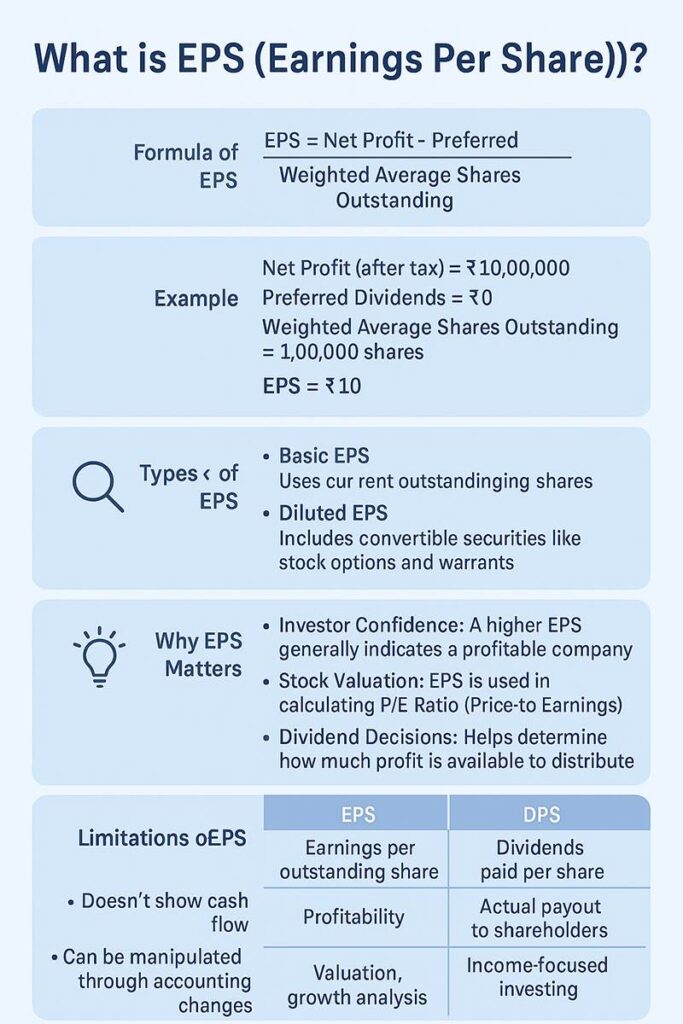
Formula of EPS:
EPS=Net Profit−Preferred DividendsWeighted Average Shares Outstanding\text{EPS} = \frac{\text{Net Profit} – \text{Preferred Dividends}}{\text{Weighted Average Shares Outstanding}}EPS=Weighted Average Shares OutstandingNet Profit−Preferred Dividends
Example:
Let’s say:
- Net Profit (after tax) = ₹10,00,000
- Preferred Dividends = ₹0
- Weighted Average Shares Outstanding = 1,00,000 shares
EPS=10,00,000−01,00,000=₹10\text{EPS} = \frac{10,00,000 – 0}{1,00,000} = ₹10EPS=1,00,00010,00,000−0=₹10
This means the company generated ₹10 profit per share.
Types of EPS:
- Basic EPS: Uses the current outstanding shares.
- Diluted EPS: Includes convertible securities like stock options and warrants, giving a more conservative view.
Why EPS Matters?
- Investor Confidence: A higher EPS generally indicates a profitable company.
- Stock Valuation: EPS is used in calculating P/E Ratio (Price-to-Earnings), another key valuation metric.
- Dividend Decisions: Helps determine how much profit is available to distribute.
EPS vs. Dividend per Share (DPS)
| Metric | EPS | DPS |
|---|---|---|
| Definition | Earnings per outstanding share | Dividends paid per share |
| Indicates | Profitability | Actual payout to shareholders |
| Used for | Valuation, growth analysis | Income-focused investing |
Limitations of EPS
- Doesn’t show cash flow
- Can be manipulated through accounting changes
- Doesn’t reflect debt or capital structure
Final Thoughts
EPS is a fundamental metric to evaluate a company’s earning strength on a per-share basis. However, it should not be used in isolation. Combine EPS analysis with revenue trends, margins, debt levels, and industry benchmarks for a complete picture.